

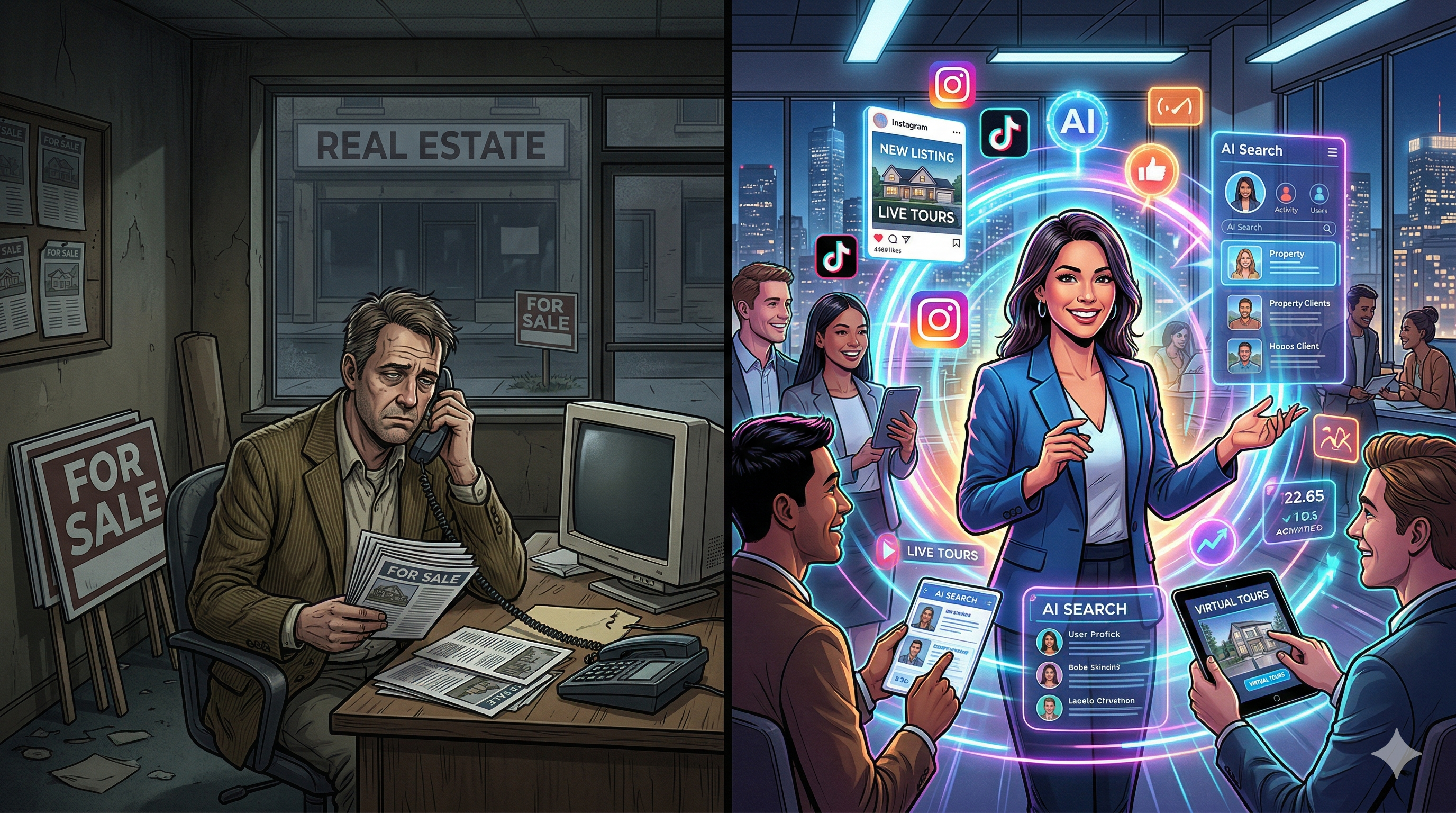
The Shift Is Already Happening—Most Agents Just Haven’t Realized It Yet
Something has changed in real estate—and not in a subtle way.
If you’ve been in the business for any length of time, you’ve probably felt it. Leads don’t behave the same. Buyers show up more informed. Sellers ask different questions. And the traditional “just listed, just sold” rhythm that used to generate momentum feels quieter.
This isn’t a market cycle. It’s a behavior shift.
And while a lot of agents are still trying to solve it with more ads, more automation, or more platforms, the agents pulling ahead have made a different realization: the way people choose an agent has fundamentally changed.
The End of “Perfect” Real Estate Content
For years, the industry trained agents to present a curated version of success. Clean photos. Smooth closings. Carefully worded captions. The message was always the same: everything is working, everything is easy.
But when you make the job look easy, you unintentionally make yourself replaceable.
Consumers don’t need to see perfection. They need to understand complexity. They want to know what happens when a deal almost falls apart. They want insight into inspections, negotiations, financing issues— the parts of the process that actually require skill.
That’s where trust is built.
Not in the highlight reel—but in the reality of the work.
Consistency Isn’t a Strategy—It’s a Requirement
One of the biggest mistakes agents still make is treating content like something they do when they “have time.”
The agents gaining traction right now treat content like infrastructure.
They don’t wait for inspiration. They document what’s already happening:
A buyer question becomes a post. A deal challenge becomes a lesson. A repeated conversation becomes content.
Over time, that consistency compounds—not because of one viral post, but because the audience begins to associate that agent with reliability and presence.
The Quiet Takeover of AI-Driven Search
This is where things get even more interesting—and where most agents are underestimating what’s happening.
Search behavior has changed.
People aren’t just typing into Google anymore. They’re asking questions in conversational formats—through AI tools, voice assistants, and search platforms that deliver answers, not just results.
That shift changes everything.
Because now, the agents who show up are the ones consistently answering real questions:
What’s it like to live here? What should I watch out for? How competitive is this market?
If your content answers those questions, you become part of the system. If it doesn’t—you don’t exist in that conversation.
Why Your Brand Matters More Than Your Brokerage
At the same time, there’s another shift happening behind the scenes.
The platforms agents rely on—portals, CRMs, transaction systems— are collecting and learning from the data being entered into them every day.
Over time, those systems reduce dependency on the individual agent.
Unless the agent has something those systems can’t replicate.
That “something” is personal brand.
Not logos. Not colors. But recognition, trust, and authority.
The kind of presence where someone says, “I’ve been watching your content—I feel like I already know how you work.”
The New Reality: Visible vs. Invisible
There used to be a middle ground in this business.
You could rely on referrals, relationships, and reputation without needing a strong online presence.
That middle ground is disappearing.
Today, agents fall into two categories:
Those who are visible—and those who are not.
And when buyers or sellers start their search, they can only choose from the agents they can find.
Where This Is All Going
Despite all of this change, one thing hasn’t shifted.
Real estate is still a human business.
People still need guidance. They still need reassurance. They still need someone who can navigate uncertainty and advocate for them.
Technology hasn’t replaced that—it’s just changed how people find it.
The agents who will dominate the next phase of this industry aren’t the ones resisting change—or blindly automating everything.
They’re the ones who combine both:
Human expertise on the front end. Digital presence on the back end.